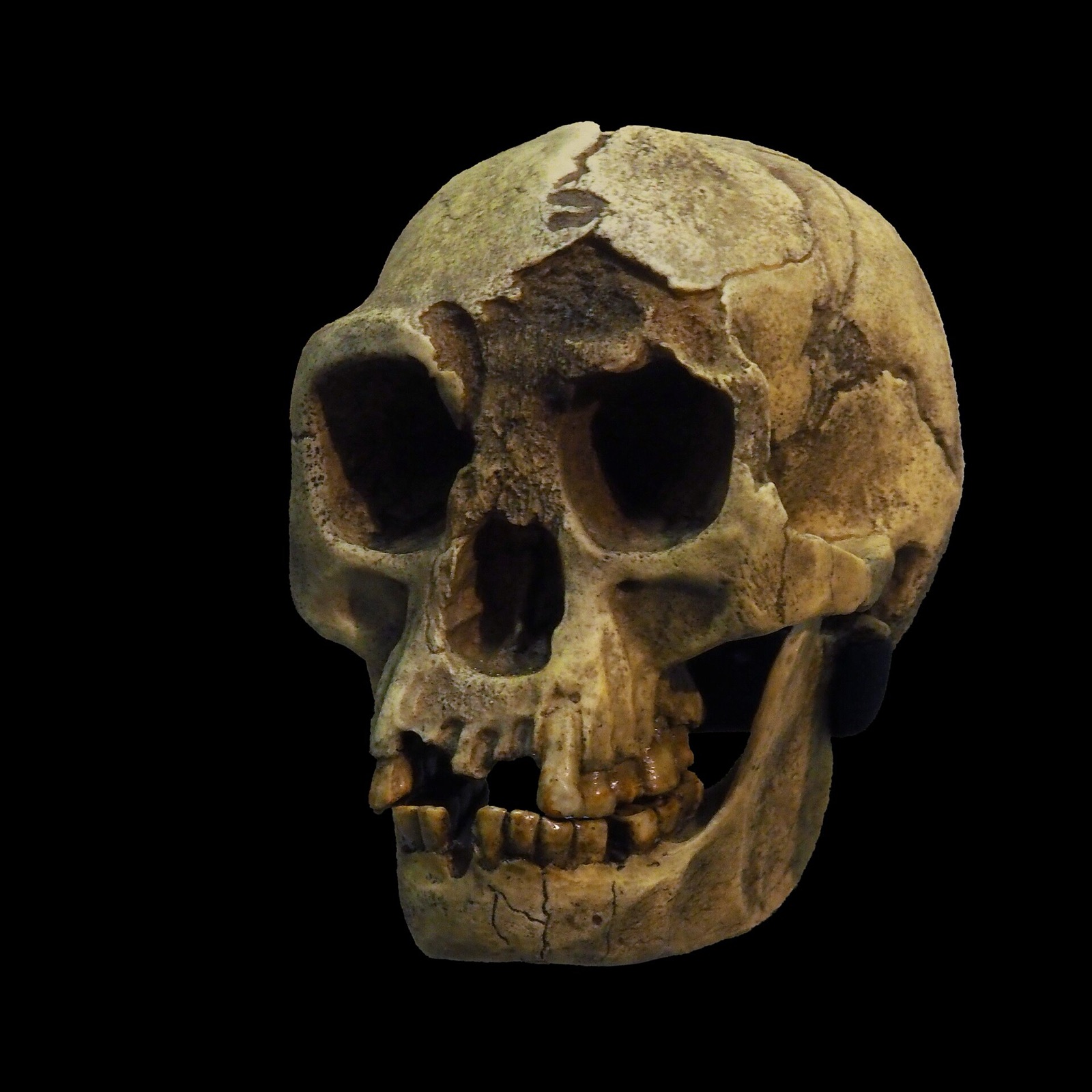
Until about twenty years ago, the story of the last few hundred thousand years seemed fairly simple: Neanderthals in Europe, Homo erectus lingering in Asia, and our own species rising in Africa. Then the surprises started coming. A tiny human on an Indonesian island. An entirely new group of humans identified from a sliver of finger bone. A small-brained species deep in a South African cave, far younger than anyone expected. The more we look, the more crowded the human family becomes.
The Denisovans: a species found in a test tube
Denisova Cave sits in the Altai Mountains of southern Siberia. In 2008, archaeologists found a tiny fragment of a finger bone from a young girl in one of its layers. When Svante Pääbo's team sequenced its DNA, they found it belonged to neither Neanderthals nor modern humans. Published in 2010, it was the first time a new group of humans had been identified from genetics rather than anatomy. They were named Denisovans, after the cave.
Denisovans were close cousins of Neanderthals, and like them, interbred with our ancestors. Today, people in Papua New Guinea and Aboriginal Australians carry the most Denisovan DNA, several percent of their genomes, and smaller amounts appear across Asia. Tibetans inherited a Denisovan version of a gene, EPAS1, that helps them cope with life at high altitude.
In 2018, researchers announced a bone fragment from the same cave belonging to a girl, nicknamed "Denny," whose mother was a Neanderthal and whose father was a Denisovan. She was a first-generation hybrid, direct proof that the groups met and mixed.
For years we knew the Denisovans' genes better than their faces.
Putting a face to the name
Denisovan fossils are frustratingly scarce: a few teeth, bone fragments, and a jawbone from Baishiya Karst Cave on the Tibetan Plateau identified in 2019 through ancient proteins. Then came the "Dragon Man." A massive skull from Harbin in northeast China, reportedly found in the 1930s and hidden in a well for decades, was named Homo longi in 2021. In June 2025, two studies, one analysing ancient proteins and one recovering mitochondrial DNA from tartar on the teeth, concluded that the Harbin skull is Denisovan. Some scientists still question parts of the evidence. If it's right, we finally know what a Denisovan looked like: a big, broad face, huge molars and a large brain.
The hobbits of Flores
In 2003, an Australian-Indonesian team excavating Liang Bua cave on the island of Flores, in Indonesia, found the skeleton of an adult female who stood barely more than a metre tall and had a brain about the size of a chimpanzee's. Published in 2004, the species was named Homo floresiensis, and the press immediately called it "the hobbit."
Some critics argued the skeleton was a modern human with a disease. But more individuals were found, and the anatomy, especially of the wrists and feet, looked genuinely ancient. Revised dating published in 2016 placed the skeletons at roughly 100,000–60,000 years old. Even older fossils from Mata Menge, elsewhere on Flores, suggest small-bodied hominins lived on the island about 700,000 years ago. A leading explanation is island dwarfism: on small islands with limited food, large animals sometimes evolve to be smaller. Flores also had dwarf elephant relatives called Stegodon.
In 2019, another small-bodied species, Homo luzonensis, was described from Callao Cave in the Philippines, at least 50,000 years old. Island Southeast Asia was clearly a laboratory for human evolution.
Homo naledi and the Rising Star cave
In 2013, two recreational cavers, Rick Hunter and Steven Tucker, squeezed through a narrow crack in the Rising Star cave system near Johannesburg and found bones scattered across a chamber floor. The palaeoanthropologist Lee Berger put out a call for scientists who were small enough, and brave enough, to fit through a chute only about 18 centimetres wide. Six women scientists, dubbed the "underground astronauts," did the excavation.
They recovered more than 1,500 fossil pieces from at least fifteen individuals, the largest single collection of hominin fossils ever found in Africa. Named Homo naledi in 2015 (naledi means "star" in the Sotho language), the species had a small brain, curved fingers for climbing, and modern-looking feet and wrists. When the fossils were dated in 2017, they turned out to be only about 335,000–236,000 years old, which means a small-brained hominin was alive in Africa at roughly the same time as early Homo sapiens.
How did so many bodies end up in such a remote chamber? Berger's team has argued that naledi deliberately placed its dead there, and in 2023 they claimed evidence of burials and engravings. Many other researchers say the evidence doesn't yet support those claims. The debate is one of the liveliest in the field.
What these discoveries mean
Put together, they tell a clear story: for most of our species' history, we shared the planet with other kinds of humans. Neanderthals, Denisovans, floresiensis, luzonensis, naledi and perhaps others we haven't found yet. Our modern situation, as the only human species alive, is the unusual one.