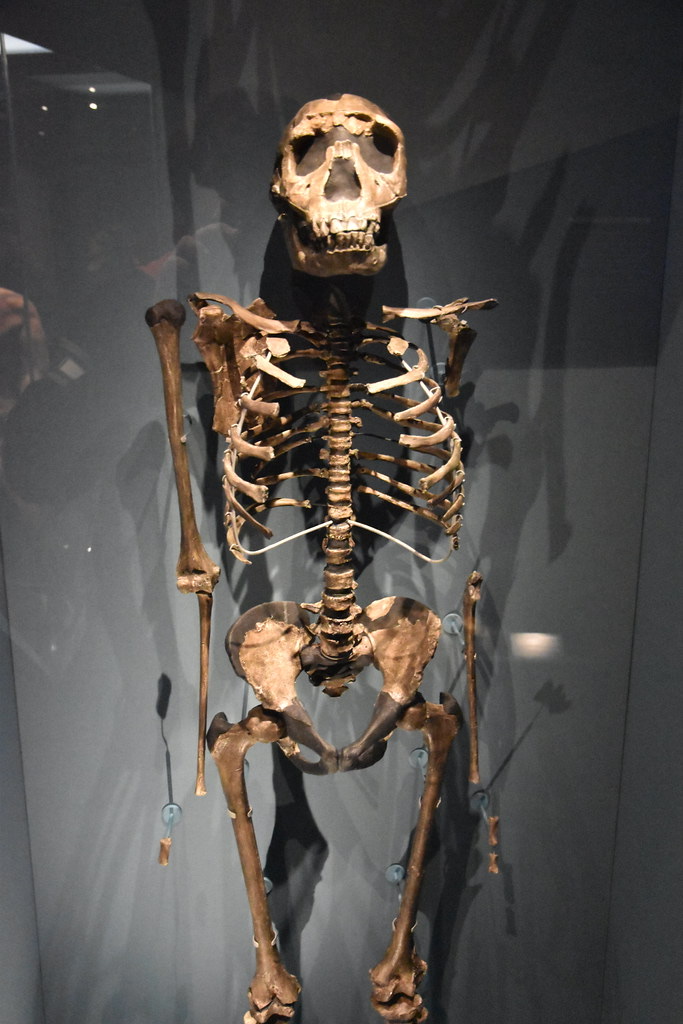
Above: a cast of the Turkana Boy skeleton, KNM-WT 15000 (public domain). If you could put one early human in modern clothes and walk them through Grand Central at rush hour, Homo erectus would be the best bet for not drawing stares. At least from the neck down. This was the first hominin with a body basically like ours: tall, long-legged, narrow-hipped, built for walking long distances in the heat. And it was the first to leave Africa, spreading as far as the islands of Indonesia. It also lasted an astonishingly long time, well over a million years.
A Dutch doctor goes looking
The first Homo erectus fossil was found by someone who went looking for it on purpose, which almost never happens. In the late 1880s a young Dutch anatomist named Eugène Dubois was convinced that the "missing link" between apes and humans would be found in Southeast Asia. He joined the Dutch colonial army as a medical officer so he could get to the Dutch East Indies. In 1891, at Trinil on the island of Java, his workers found a skullcap, and later a thighbone. Dubois named the species Pithecanthropus erectus, "upright ape-man." Today we call it Homo erectus, and the fossil is known as Java Man.
In the 1920s and 30s, excavations at Zhoukoudian, near Beijing, uncovered many more fossils, nicknamed Peking Man. Tragically, the original Peking Man fossils disappeared in 1941, while being packed for shipment to the United States as Japan invaded. They have never been found. Luckily, the anatomist Franz Weidenreich had made detailed casts and descriptions.
Turkana Boy
The most complete erectus skeleton ever found came from Nariokotome, on the west side of Lake Turkana in Kenya. In August 1984, the legendary Kenyan fossil hunter Kamoya Kimeu spotted a small piece of skull on a hillside. Over the following seasons, the team, led by Richard Leakey and Alan Walker, recovered most of a skeleton of a young male, catalogued as KNM-WT 15000 and nicknamed Turkana Boy.
He lived around 1.5 million years ago. Based on his teeth, he was probably around eight or nine years old when he died, younger than first thought, because erectus seems to have grown up faster than we do. He was already about 1.6 metres tall. His long legs, narrow body and barrel chest look strikingly modern.
Turkana Boy was taller at eight or nine than many adult australopiths ever got.
Built to go the distance
Why the new body? A popular hypothesis, put forward by Dennis Bramble and Daniel Lieberman in 2004, is that erectus was built for endurance: long legs, springy tendons, a big gluteus maximus for stabilising the trunk, and probably the ability to sweat to stay cool. That would make it good at covering big distances to find food, and possibly at "persistence hunting," running prey to exhaustion in the heat. Not everyone agrees on the running part, but the long-distance walking is clear from the skeleton.
The teardrop tool
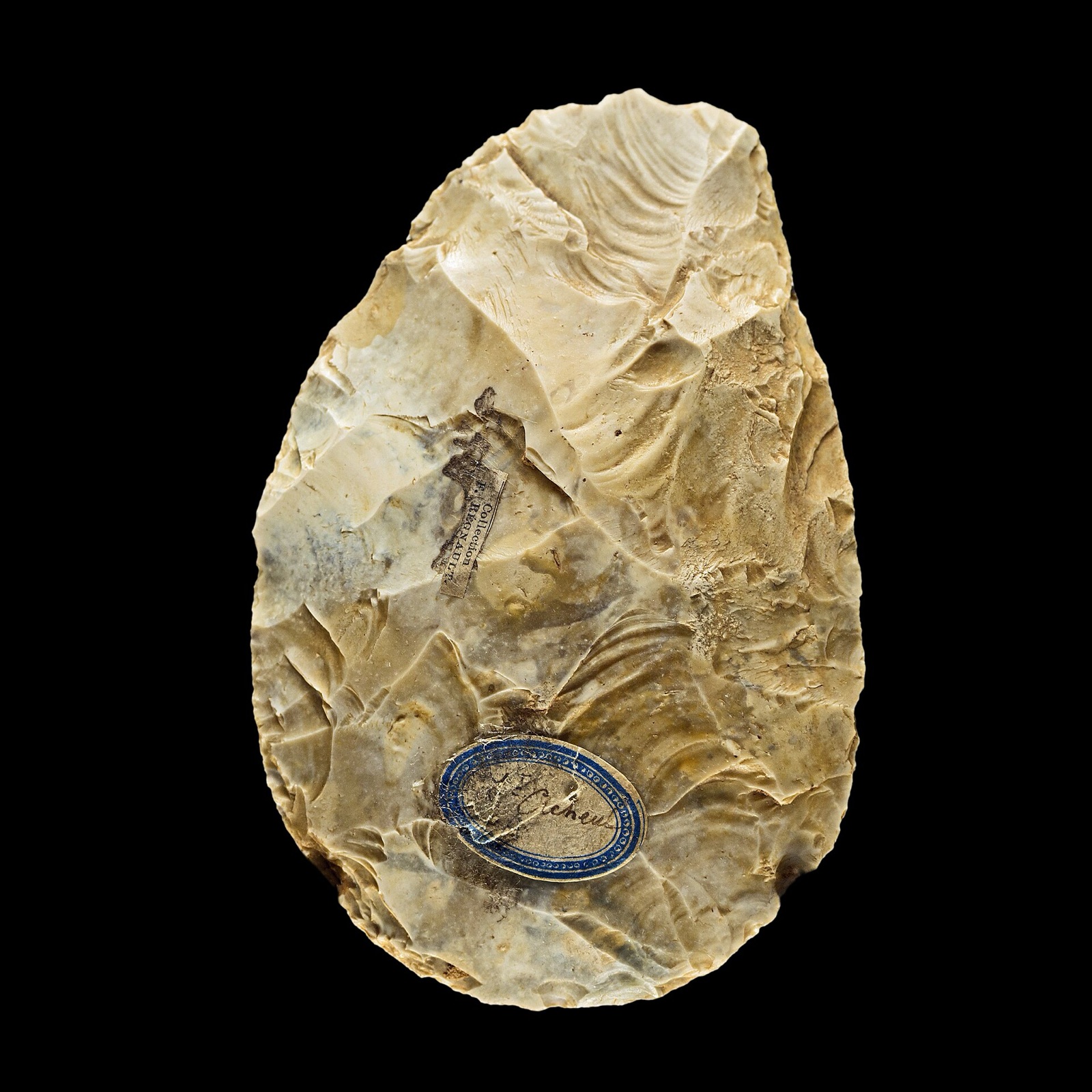
Around 1.76 million years ago, at Kokiselei in Kenya, a new kind of tool appears: the Acheulean handaxe, named after Saint-Acheul in France where they were first described. Handaxes are teardrop-shaped, worked on both faces, with a symmetrical outline. Making one means imagining a shape inside the stone and working toward it, flake by flake.
The design was so successful that it was made, with variations, for more than a million years, across Africa, Europe and western Asia. Some later handaxes are so carefully symmetrical that archaeologists wonder whether they were also about showing off skill.
Out of Africa, the first time
For a long time, scientists assumed humans left Africa only once they had big brains and advanced tools. Then came Dmanisi. At this medieval town site in the Republic of Georgia, excavations since the 1990s have uncovered several hominin skulls about 1.8 million years old. They're small-brained, with simple Oldowan-style tools, and they're sitting right at the gateway between Africa and Asia.
Skull 5 from Dmanisi, published in 2013, combines a tiny braincase with a huge face. Because the five Dmanisi skulls look so different from each other yet lived at the same place and time, some researchers argued that many early Homo "species" might actually be variations within a single, highly variable species. It's a debate that's still running.
Fire
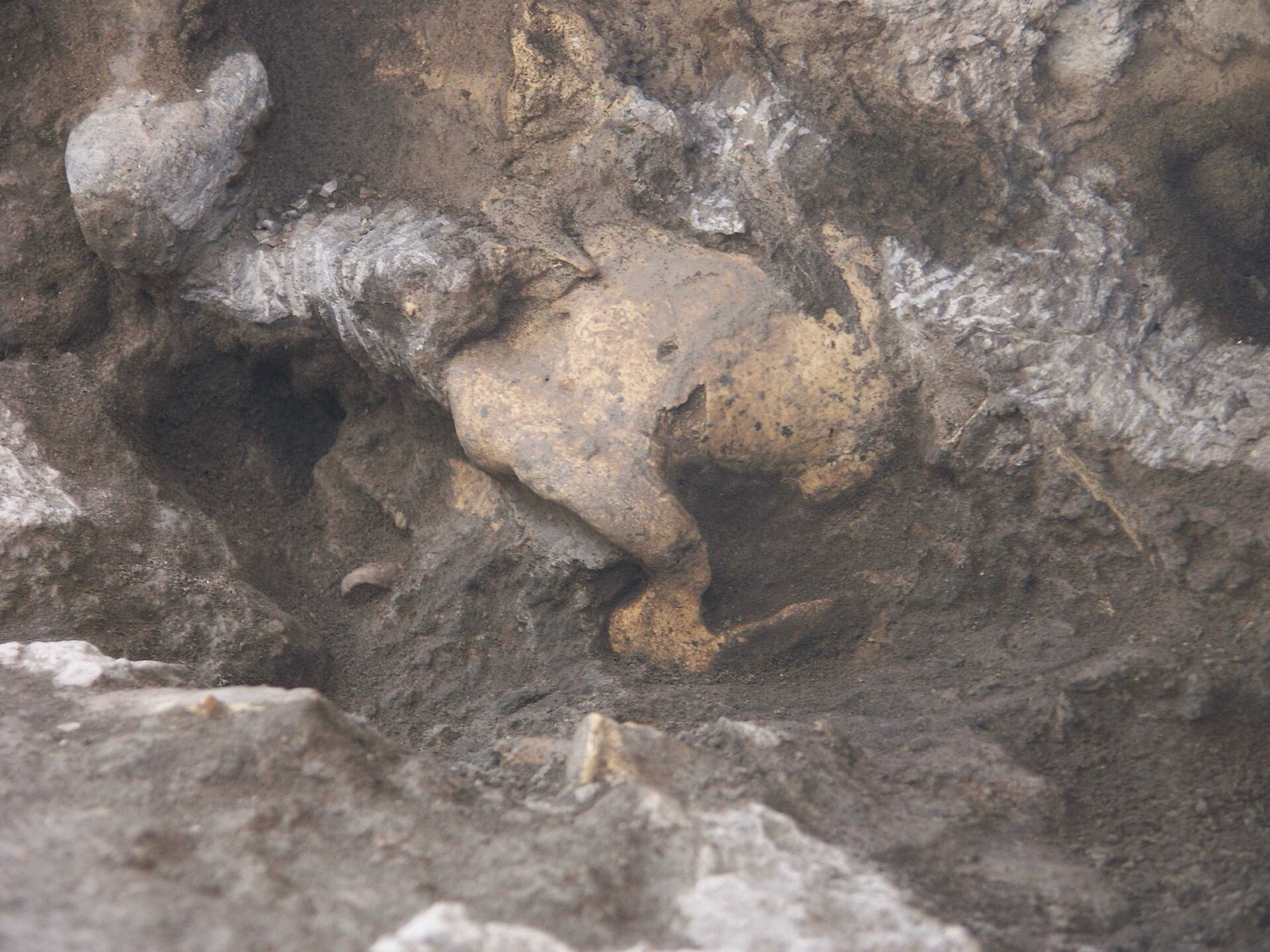
When did humans first control fire? It's one of the hardest questions to answer, because natural fires happen too. Evidence of burnt bone and plant ash deep inside Wonderwerk Cave in South Africa, about one million years old, is among the strongest early cases, since lightning doesn't strike inside caves. Hearth evidence becomes much clearer by around 800,000–400,000 years ago at sites in Israel and Europe. Cooking makes food easier to digest, which could have helped power growing brains.
The last of the line
Homo erectus survived on Java for a remarkably long time. Fossils from Ngandong, on the Solo River, were dated in 2019 to roughly 117,000–108,000 years ago, by which time our own species already existed in Africa. A species that began almost two million years earlier was still walking the riverbanks of Java. It's one of the most successful human species ever, by staying power alone.