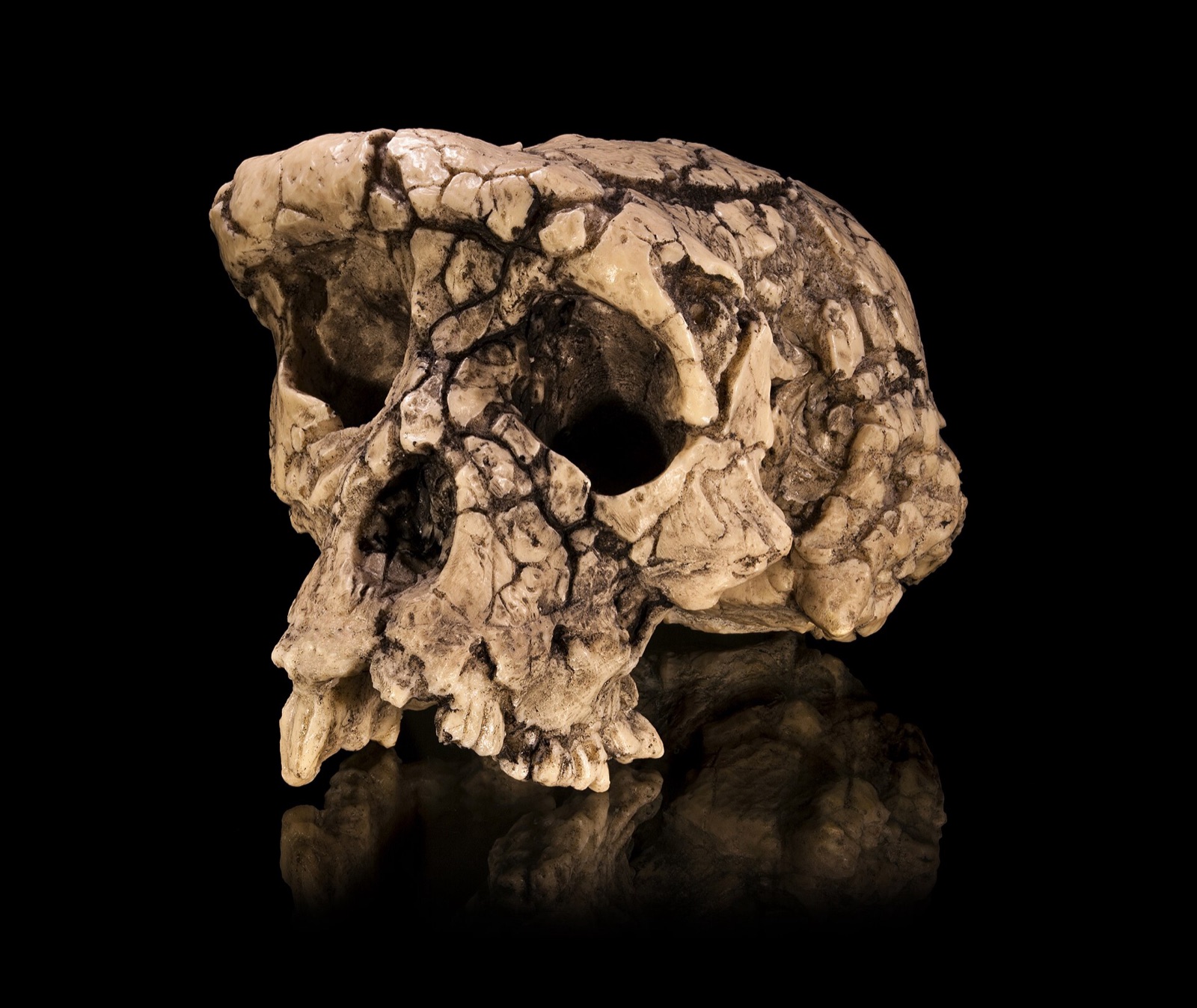
Somewhere between about six and eight million years ago, a population of African apes split in two. One branch would eventually lead to today's chimpanzees and bonobos. The other would lead, through a long and tangled series of species, to us. Nobody was there to mark the moment, and the fossils from that time are rare, broken and hotly argued over. But a handful of discoveries since 2000 have taken us closer to the fork than anyone thought possible.
Toumaï, "hope of life"
In July 2001, in the shifting dunes of the Djurab Desert in northern Chad, a student named Ahounta Djimdoumalbaye spotted a skull lying in the sand. It belonged to the French-Chadian team led by the palaeontologist Michel Brunet, which had been searching the region for years. The skull was crushed and distorted, but it was clearly something remarkable: a small brain, about the size of a chimpanzee's, combined with a flattish face, a heavy brow ridge and small canine teeth.
The team named it Sahelanthropus tchadensis and gave it the nickname Toumaï, which means "hope of life" in the local Daza language, a name given to children born just before the dry season. Based on the animals found with it, it's thought to be around seven million years old.
Why does it matter? Partly because of the teeth: small canines are a hallmark of the human line, as opposed to the dagger-like canines of male apes. And partly because of where the spinal cord entered the skull, which some researchers argue points to an upright posture. Others disagree, and a thighbone found at the same site has sparked a long-running dispute over whether Sahelanthropus regularly walked on two legs.
Toumaï was found 2,500 kilometres west of the Rift Valley, which overturned the idea that the human story started only in East Africa.
Orrorin, the "Millennium Man"
A year earlier, in 2000, a team led by Brigitte Senut and Martin Pickford announced fossils from the Tugen Hills of Kenya, around six million years old. They called the species Orrorin tugenensis, from a local word meaning "original man," and the press dubbed it "Millennium Man." The key evidence is a set of thighbones whose shape, the team argued, shows the stresses of walking upright. As with Toumaï, not everyone is convinced, but Orrorin added weight to the idea that bipedalism began very early.
Ardi: fifteen years in the making
The most complete early fossil of all took a famously long time to reach the public. In the early 1990s, in the Middle Awash region of Ethiopia, a team including Tim White, Berhane Asfaw and Giday WoldeGabriel began finding fossils of a new hominin, which they named Ardipithecus ramidus. In 1994 they found pieces of a partial skeleton. It was so fragile, crushed and chalky that it took years of painstaking excavation, CT scanning and digital reconstruction to study.
In October 2009, the team finally published eleven papers in a special issue of the journal Science describing the skeleton, nicknamed "Ardi." She lived around 4.4 million years ago, stood about 1.2 metres tall and weighed perhaps 50 kilograms.
Ardi was a surprise. She didn't look like a small chimpanzee, as many expected the common ancestor might. Instead she had:
- a pelvis adapted, at least partly, for walking upright on the ground;
- a big toe that stuck out sideways, still able to grasp branches like a thumb;
- flexible hands and wrists that weren't built for knuckle-walking like a chimp;
- small canines in both males and females.
Her fossil-rich site suggests she lived in a woodland, not open grassland, which challenged an old textbook idea that our ancestors stood up to see over tall savanna grass.
Why it's so hard to be sure
It's tempting to line these species up into a neat sequence: Sahelanthropus begat Orrorin begat Ardipithecus begat Lucy. Researchers are careful not to. There are several reasons:
- Very few fossils. For this whole period we have only a few dozen individuals, mostly teeth and bone fragments.
- Convergence. Some ape-like and human-like traits evolved more than once, so a single feature can mislead.
- The common ancestor is unknown. We don't have a fossil of the last ancestor we share with chimps, so we can't be certain which traits are new.
- A bush, not a ladder. Several branches of early hominins may have existed side by side, and some may have been dead ends.
Genetic studies comparing living humans and chimpanzees estimate the split happened somewhere around six to eight million years ago, though the numbers depend on assumptions about mutation rates and generation times. The fossils so far fit comfortably into that window.
What walking gave us
One thing seems clear: walking upright came first. Big brains, stone tools and language all came millions of years later. Our earliest relatives were, in a sense, upright apes, still at home in the trees but able to stride across the ground on two legs. To see what happened next, we need to meet the most famous fossil of all, in our next post.