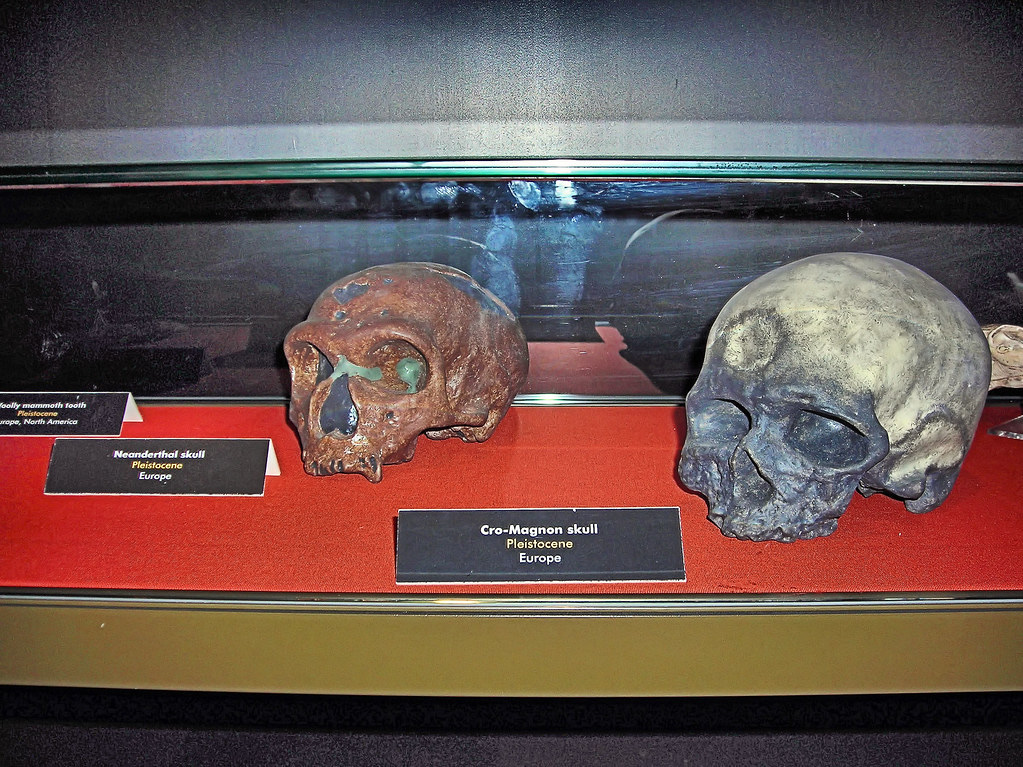
Above: skulls of an early modern human ("Cro-Magnon") and a Neanderthal side by side, Horniman Museum, London (photo: Jim Linwood, CC BY 2.0). Every person reading this belongs to a single species, Homo sapiens, "wise human," a name we gave ourselves with typical modesty. Where and when did we begin? For a long time the answer was "East Africa, about 200,000 years ago." Recent discoveries have made the story older, broader and more interesting: our species seems to have emerged across Africa, in a patchwork of connected populations, over hundreds of thousands of years.
Jebel Irhoud: 300,000 years and pushing
In 1961, miners working a barite deposit at Jebel Irhoud, in Morocco, found a fossil skull. For decades it was thought to be about 40,000 years old, perhaps an African Neanderthal. Then a team led by Jean-Jacques Hublin returned to the site, found more fossils and stone tools, and dated heated flints from the same layer. In 2017 they announced an age of roughly 300,000 years.
The Irhoud people had faces that look strikingly like ours, small and tucked under the braincase, but their braincases were long and low, more like older humans. The researchers argued they're early members of our own species, and that the modern face evolved before the modern, rounded skull. Not everyone agrees on the label, but Jebel Irhoud pushed the story back by about 100,000 years and moved it to the far north of the continent.
We got our faces before we got our round heads.
A continent-wide origin
Other early fossils come from across Africa: Florisbad in South Africa, about 260,000 years old; Omo Kibish in Ethiopia, found by Richard Leakey's team in 1967 and redated in 2022 to at least 233,000 years; and Herto, Ethiopia, about 160,000 years old. Together they suggest that Homo sapiens didn't spring from a single "Garden of Eden" but emerged gradually as populations across Africa mixed, split and came back together, sharing genes and ideas.
Blombos Cave: the first doodles
On the southern coast of South Africa, Blombos Cave overlooks the Indian Ocean. Excavations led by Christopher Henshilwood since the 1990s have found some of the earliest signs of symbolic behaviour:
- pieces of red ochre engraved with crosshatched patterns, about 75,000–100,000 years old;
- shell beads with holes and wear marks from being strung, around 75,000 years old;
- a toolkit for processing ochre into paint, stored in abalone shells, about 100,000 years old;
- a small flake of stone with a crosshatched design drawn in ochre crayon, around 73,000 years old, published in 2018 as the oldest known drawing.
Why does this matter? Because symbols mean shared meaning. A pattern drawn on purpose, or a necklace worn to say something about who you are, suggests minds that think a lot like ours.
Out of Africa, again
Small groups of Homo sapiens ventured out of Africa early. Fossils from Misliya Cave in Israel suggest a presence there around 180,000 years ago. But most people alive outside Africa today descend from a migration that began roughly 60,000–50,000 years ago. Moving through the Middle East, these people met and mixed with Neanderthals (see our Neanderthal post), and further east with Denisovans.
From there, the spread was astonishingly fast by evolutionary standards:
| Region | Arrival (approximate) | Evidence |
|---|---|---|
| Southeast Asia | By at least 50,000 years ago | Cave sites, art |
| Australia | About 50,000+ years ago | Archaeological sites (some claim older) |
| Europe | About 45,000 years ago | Bacho Kiro (Bulgaria), early genomes |
| Americas | By about 23,000–21,000 years ago | White Sands footprints, New Mexico |
| Remote Pacific | Last 3,500 years | Lapita and Polynesian voyages |
The art explosion
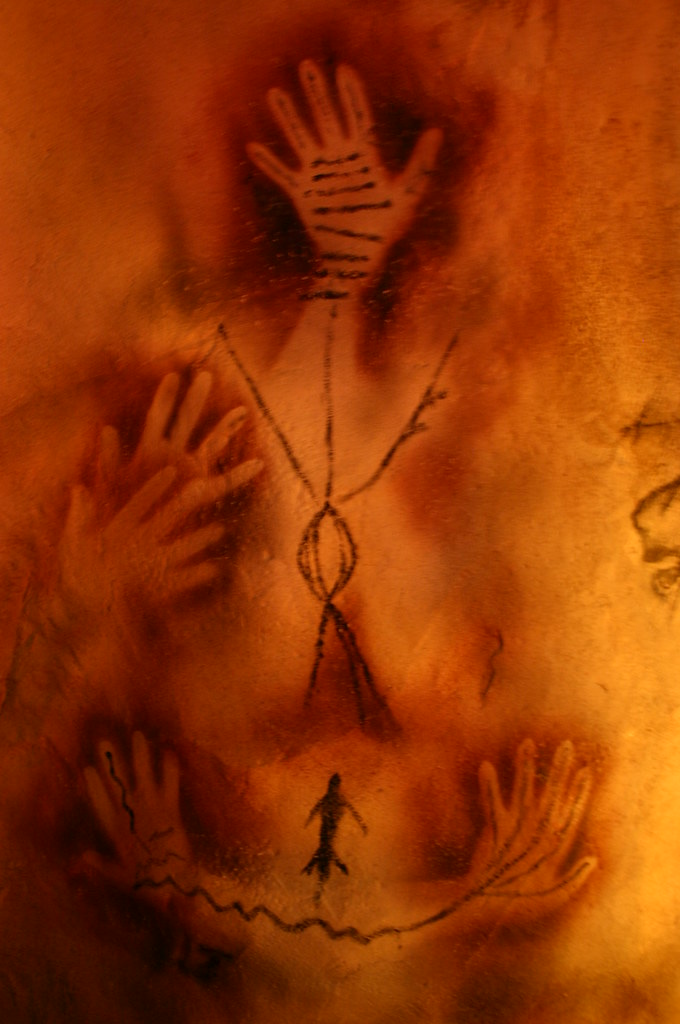
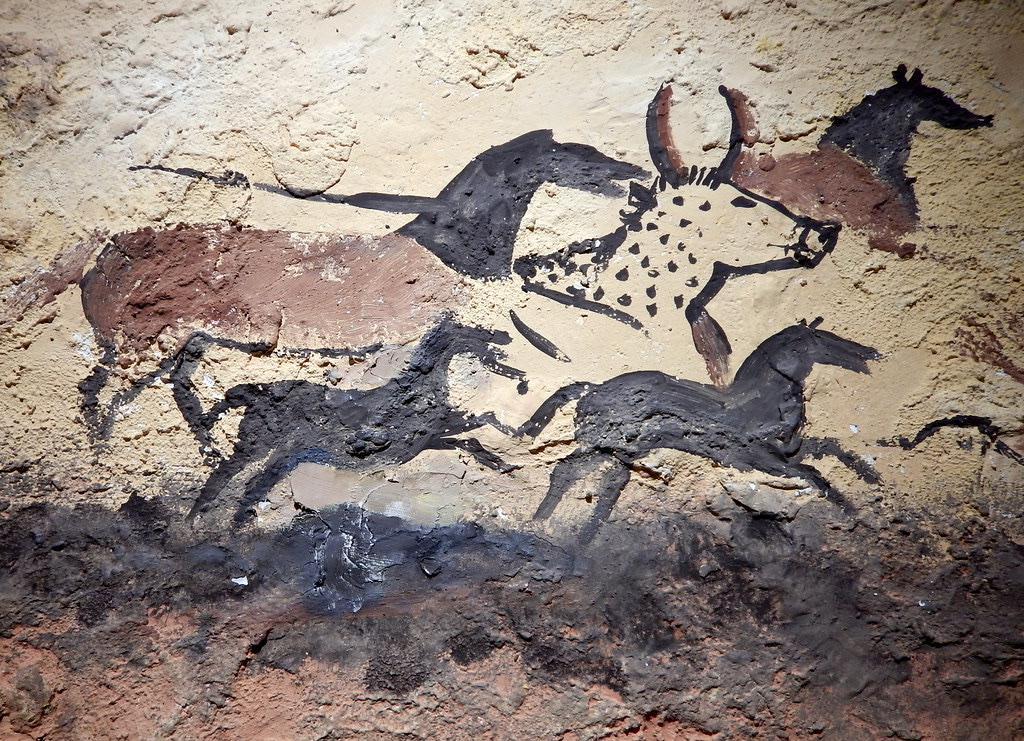
In 2024, researchers reported a cave painting on the Indonesian island of Sulawesi, showing human-like figures with a pig, dated to at least 51,200 years ago, the oldest known figurative art in the world. Europe's famous painted caves come later: Chauvet in France around 36,000 years ago, Lascaux around 17,000. Hand stencils, made by blowing pigment around a hand pressed to the rock, appear on cave walls on several continents. The hand in our logo is a nod to them.
Footprints in New Mexico
For decades the standard view was that people reached the Americas around 13,000 years ago. Then, in 2021, researchers reported human footprints at White Sands National Park in New Mexico, dated by seeds found in the same layers to about 23,000–21,000 years ago, during the height of the last Ice Age. Follow-up dating published in 2023 supported the age. Some prints were made by children and teenagers. The first Americans arrived far earlier than textbooks said.
Still evolving
Evolution didn't stop when we became "modern." In the last 10,000 years, some populations evolved the ability to digest milk as adults, others adapted to high altitudes or new diets. We're not the end point of the human story, just the latest chapter.