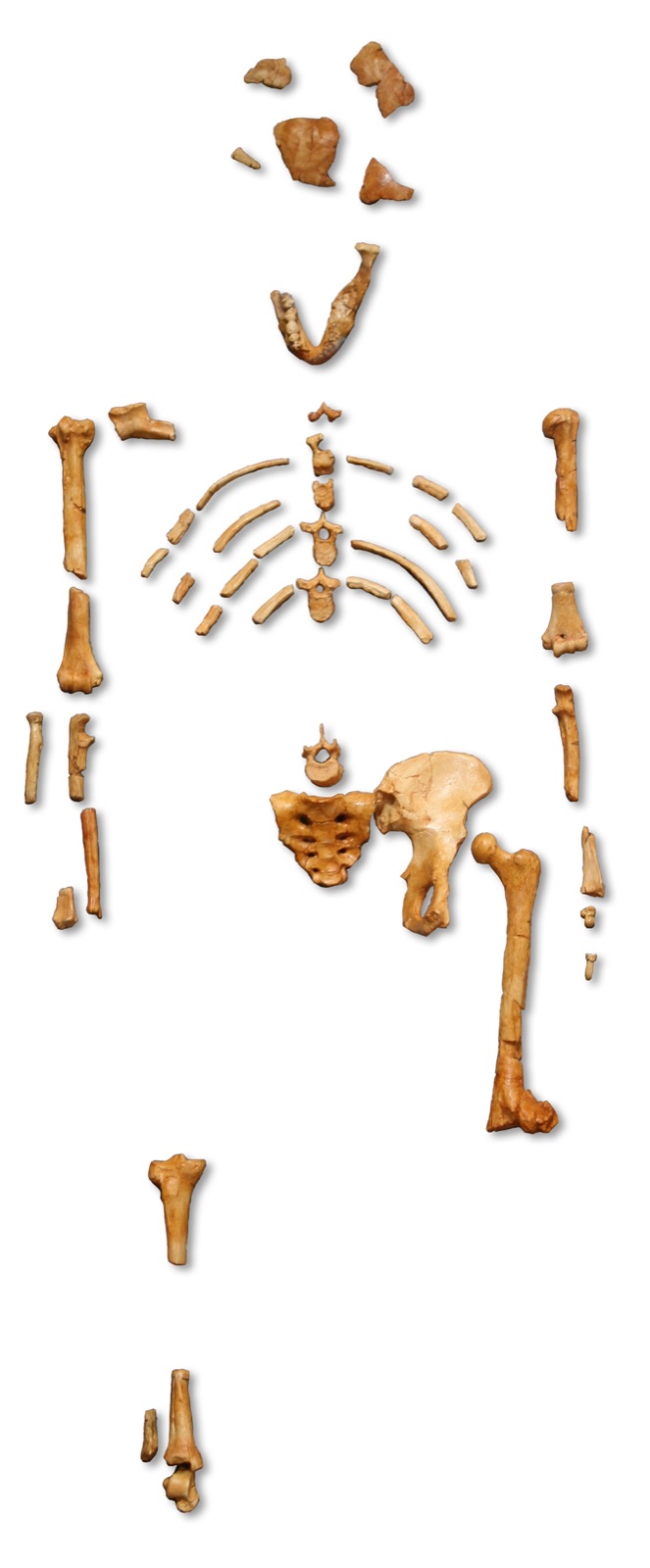
On the morning of November 24, 1974, exactly fifty-two years before this post went live, the American palaeoanthropologist Donald Johanson and his graduate student Tom Gray were surveying a gully at Hadar, in the Afar region of Ethiopia. It was hot, and they were about to head back to camp. On a whim, Johanson suggested checking one more slope. He glanced over his shoulder and saw a piece of arm bone. Then a piece of skull. Then a thighbone, vertebrae, ribs and pelvis. By the end of the dig, the team had recovered several hundred bone fragments representing about forty percent of a single skeleton.
"Lucy in the Sky with Diamonds"
That night at camp, the team celebrated with a Beatles tape playing on repeat, and someone suggested naming the skeleton after the song "Lucy in the Sky with Diamonds." The name stuck worldwide. In Ethiopia she's also known as Dinkinesh, which means "you are marvellous" in Amharic. Her catalogue number is AL 288-1.
Lucy was an adult female, small by our standards: around 1.1 metres tall and roughly 29 kilograms. She lived about 3.2 million years ago. In 1978 she and other fossils from Hadar and Laetoli were assigned to a new species, Australopithecus afarensis, the "southern ape from Afar." (Technically, the official type specimen is a jaw from Laetoli, but Lucy is by far its most famous member.)
What made Lucy so important
Before Lucy, many scientists assumed big brains came first in human evolution. Lucy turned that idea upside down:
- Her pelvis and knee show she walked upright on two legs, with a gait broadly like ours.
- Her brain was small, about the size of a chimpanzee's.
- Her arms were relatively long and her fingers curved, suggesting she still climbed trees, perhaps to sleep or escape predators.
In short, she was a creature with an ape-sized brain on top of a body built for walking. Bipedalism had arrived millions of years before big brains.
A 2016 study suggested Lucy may have died after falling from a tall tree, based on fracture patterns in her bones. Other researchers think the breaks happened after death, during fossilisation. Even 3.2 million years later, she's still generating debate.
Lucy proved that our ancestors stood up long before they got smart.
The First Family and the Dikika child
Lucy wasn't alone. In 1975, near the same site, Johanson's team found the remains of at least thirteen individuals of the same species together, nicknamed the "First Family." And in 2000, at Dikika, not far from Hadar, a team led by Zeresenay Alemseged discovered the skeleton of an afarensis child, about three years old, from around 3.3 million years ago. Published in 2006 and nicknamed Selam ("peace"), she showed how this species grew up.
Footprints in volcanic ash
Bones tell us how a body was built. Footprints tell us how it moved. At Laetoli, in northern Tanzania, about 3.66 million years ago, a nearby volcano called Sadiman puffed out a fine layer of ash. Light rain turned the ash into something like wet cement. Animals walked across it: hares, antelopes, birds, rhinos. And so did a group of hominins. Then more ash fell, burying and preserving the tracks.
The first animal tracks at Laetoli were spotted in 1976, reportedly when members of Mary Leakey's team were goofing around throwing elephant dung at each other and one of them fell over. In 1978 the team uncovered a hominin trail around 27 metres long, with around seventy footprints made by at least two individuals walking side by side or one stepping in the other's prints.
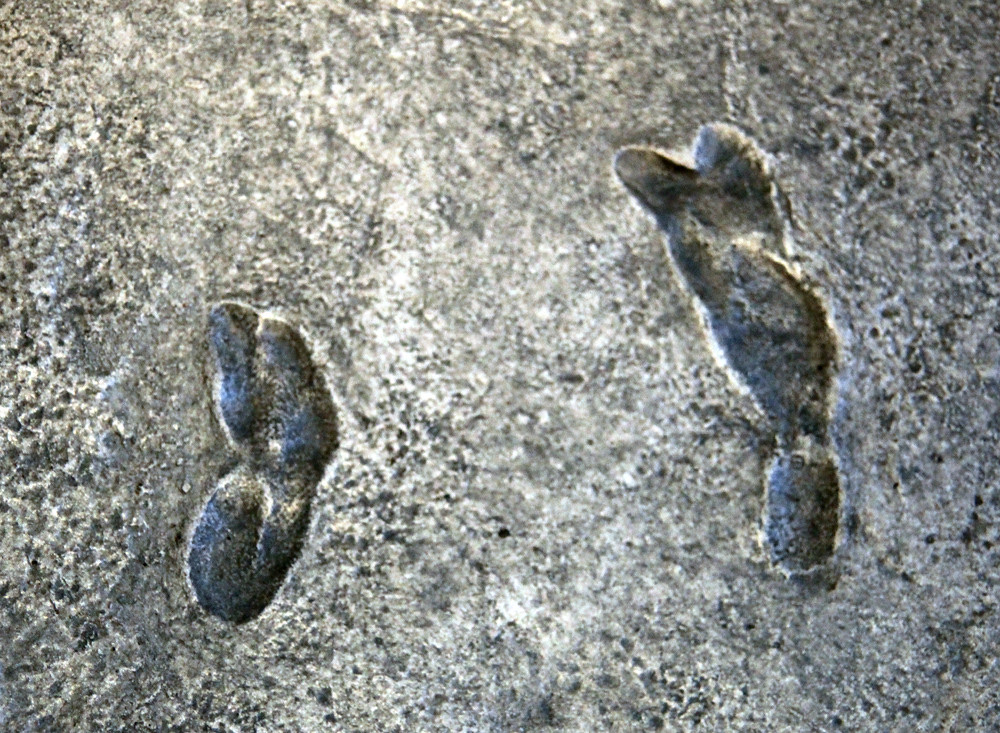
The prints are astonishingly human-like. They show a heel strike, an arch and a big toe aligned with the other toes, not sticking out sideways like a chimpanzee's. Most researchers attribute them to Australopithecus afarensis, Lucy's species. More prints found nearby in 2015 suggest one individual was quite tall, which hints at big size differences between males and females.
A crowded neighbourhood
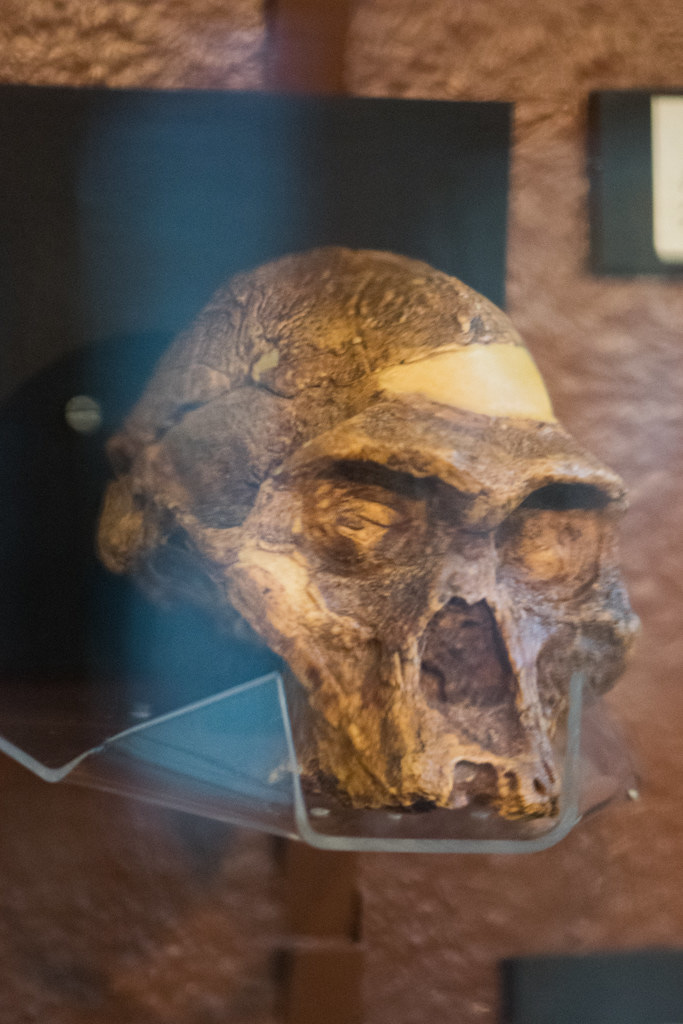
For a long time Lucy's species looked like the only hominin of its time. Not any more. Fossils now suggest several kinds of hominin lived in Africa between about 4 and 3 million years ago, including Australopithecus anamensis, known from an almost complete 3.8-million-year-old skull found at Woranso-Mille in Ethiopia and published in 2019, and other, more contested species. Some footprints at Laetoli's Site A, re-examined in 2021, may even have been made by a different kind of biped. The human family was already a bush, not a single line.
Where Lucy lives now
The original Lucy is kept at the National Museum of Ethiopia in Addis Ababa, in a secure vault, with a cast on public display. She toured the United States between 2007 and 2013, a trip some scientists criticised as too risky for such a fragile fossil. Here in New York, you can see a life-sized reconstruction of her species at the American Museum of Natural History. More on that in How Do We Know?