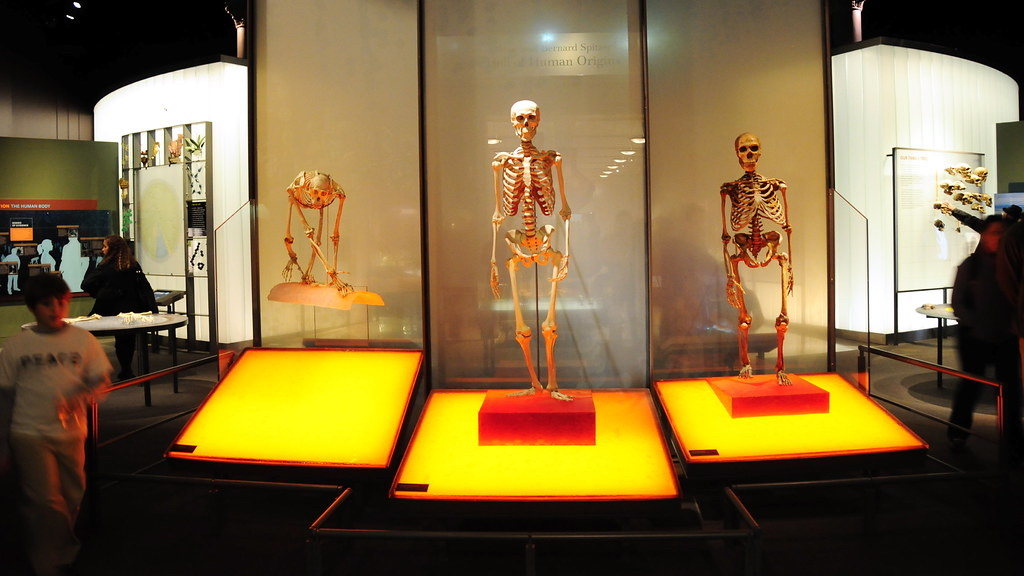
Above: the Anne and Bernard Spitzer Hall of Human Origins at the American Museum of Natural History, New York (photo: VSmithUK, CC BY 2.0). Readers often ask us some version of the same question: "How can anyone possibly know that a bone is 3.2 million years old?" It's a fair question, and the answer is one of the great stories of modern science. Studying human origins is detective work, using geology, physics, chemistry, genetics and anatomy, with each line of evidence checking the others. Here's how it works, and why scientists sometimes change their minds.
Step one: finding a fossil
Fossils are rare. Most animals that die are eaten, rot or are scattered long before they can be buried. The ones that survive were usually covered quickly by sediment, such as river mud, lake silt or volcanic ash, and then mineralised over long periods. Millions of years later, erosion has to bring them back to the surface at just the right time, before they crumble away.
So fossil hunters walk. Teams survey exposed sediments in places like the Afar region of Ethiopia, the Turkana Basin of Kenya and the caves of South Africa, scanning the ground for a glint of bone or tooth. When something turns up, the area is mapped, excavated and often sieved, grain by grain.
Step two: telling the time
There's no single "fossil clock." Different methods work over different time spans and materials:
| Method | What it dates | Useful range |
|---|---|---|
| Radiocarbon | Organic material (bone collagen, charcoal) | Up to about 50,000 years |
| Argon-argon / potassium-argon | Volcanic ash and lava layers | Thousands to billions of years |
| Uranium series | Cave flowstone, coral, teeth | Up to about 500,000 years |
| Luminescence (TL, OSL) | When sediment or flint was last exposed to light or heat | Up to a few hundred thousand years |
| Electron spin resonance | Tooth enamel | Up to a few million years |
| Palaeomagnetism | Magnetic flips recorded in rock | Matches layers to a global timeline |
East Africa is a gift to dating because of its volcanoes. Layers of ash (tuffs) contain crystals that can be dated very precisely with argon-argon methods. A fossil sandwiched between two dated ash layers must be between their ages. That's how Lucy got her 3.2-million-year date. Animal fossils help too: some species, like ancient pigs, evolved quickly, so their teeth act as a rough clock.
Lucy's age doesn't come from Lucy. It comes from the ash layers above and below her.
Step three: reading the bones
Anatomists compare a new fossil with known ones, measuring teeth, skulls, limb bones and joints. CT scanning now lets researchers see inside fossils without damaging them, and digitally "uncrush" distorted skulls. That's how the Yunxian skull from China was re-examined in 2025 (see Discoveries). 3D printing lets copies be shared around the world.
Step four: molecules
The biggest revolution of the last twenty years has been ancient molecules.
- Ancient DNA. DNA breaks down over time, especially in warm climates, but in cool caves it can survive tens of thousands of years or more. The oldest hominin DNA so far comes from the Sima de los Huesos in Spain, about 430,000 years old. Researchers can now even recover human DNA from cave sediment, without any bones at all.
- Ancient proteins. Proteins, especially in tooth enamel, survive much longer than DNA. They've been used to place Homo antecessor (about 800,000 years old) on the family tree and, in 2025, to study Paranthropus teeth around two million years old from South Africa. Proteins also helped identify the Harbin skull as Denisovan.
- Living genomes. Our own DNA carries the history of our ancestors, including traces of "ghost" populations no fossil has yet revealed.
So, how many kinds of human were there?
There's no single agreed number, because scientists disagree about where to draw lines between species. But roughly twenty hominin species are widely recognised, from Sahelanthropus seven million years ago to us. You can explore them on one timeline in our Species Explorer. The bigger lesson is the shape: a branching bush, with several species often alive at the same time, not a single march from ape to human.
Seeing the evidence in New York
You don't need to fly to Ethiopia to stand face to face with the evidence. New York is one of the best cities in the world for human origins:
- American Museum of Natural History, Central Park West at 79th Street. The Anne and Bernard Spitzer Hall of Human Origins, opened in 2007, has life-sized reconstructions of early hominins, including Lucy's species, a cast of the Laetoli footprints, casts of famous skulls and skeletons including Turkana Boy, and replicas of Ice Age art.
- Research in the city and state. New York is home to strong human-evolution research, including at the museum itself, at New York University, through the New York Consortium in Evolutionary Primatology (NYCEP) linking several institutions, and at Stony Brook University on Long Island, which runs the Turkana Basin Institute in Kenya.
We're not affiliated with any of these institutions. We just love them, and we think the best way to finish this journal is with an invitation: go and look for yourself.