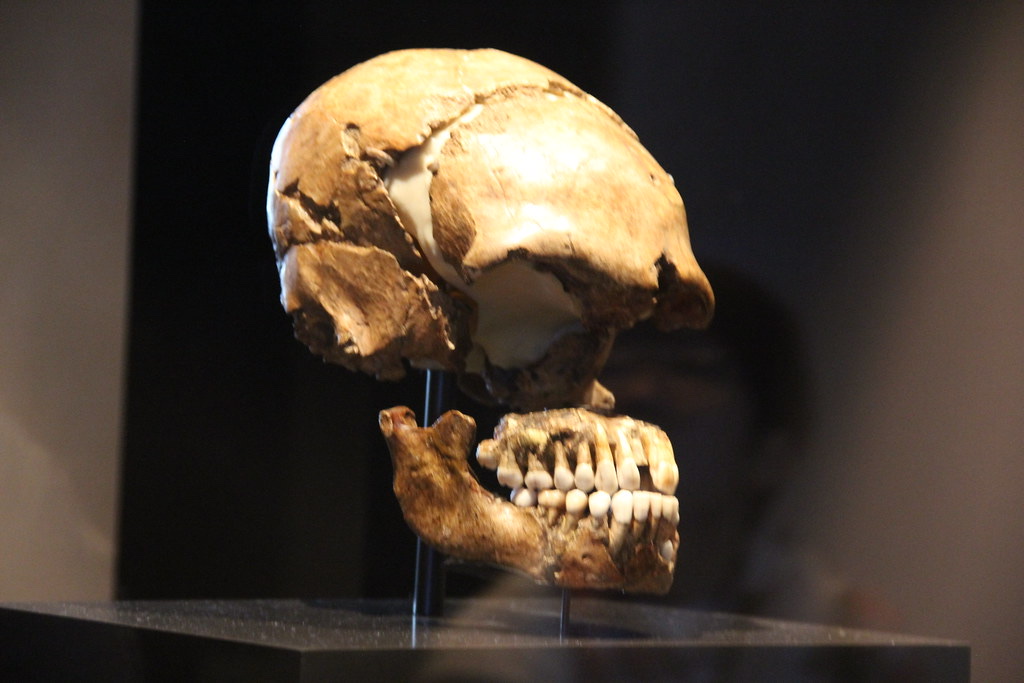
Above: a Neanderthal skull (photo: Gary Lee Todd, CC0). Few creatures have had a worse press than the Neanderthals. For much of the twentieth century, calling someone a "Neanderthal" meant calling them a knuckle-dragging thug. Cartoons showed them hunched, hairy, grunting and dim. Almost every part of that picture turned out to be wrong. The real Neanderthals were skilled, adaptable people who survived for hundreds of thousands of years in Ice Age Europe, cared for their sick, made jewellery and, as we now know, had children with our ancestors.
A skeleton in a limestone quarry
In August 1856, quarry workers clearing a small cave in the Neander Valley near Düsseldorf, Germany, found a skullcap and some limb bones. A local schoolteacher, Johann Carl Fuhlrott, recognised they were unusual, with a heavy, low skull and prominent brow ridges. In 1864, the anatomist William King gave the bones a species name: Homo neanderthalensis. (Thal, later Tal, means valley.) It was the first fossil human species ever named, three years after Darwin's On the Origin of Species. Earlier Neanderthal finds, in Belgium in 1829 and Gibraltar in 1848, had gone unrecognised.
How the brute was invented
In 1908 an almost complete Neanderthal skeleton was found at La Chapelle-aux-Saints in France. The French palaeontologist Marcellin Boule reconstructed it as a stooped, bent-kneed, ape-like figure, and his influential studies shaped the public image for decades. The trouble was that the individual, nicknamed "the Old Man," had severe arthritis and had lost most of his teeth. In 1957, a re-examination showed Neanderthals stood upright just like us. The Old Man's condition also hints at something else: someone may have helped him eat.
The famous hunched Neanderthal was really an old man with bad arthritis.
Built for the cold
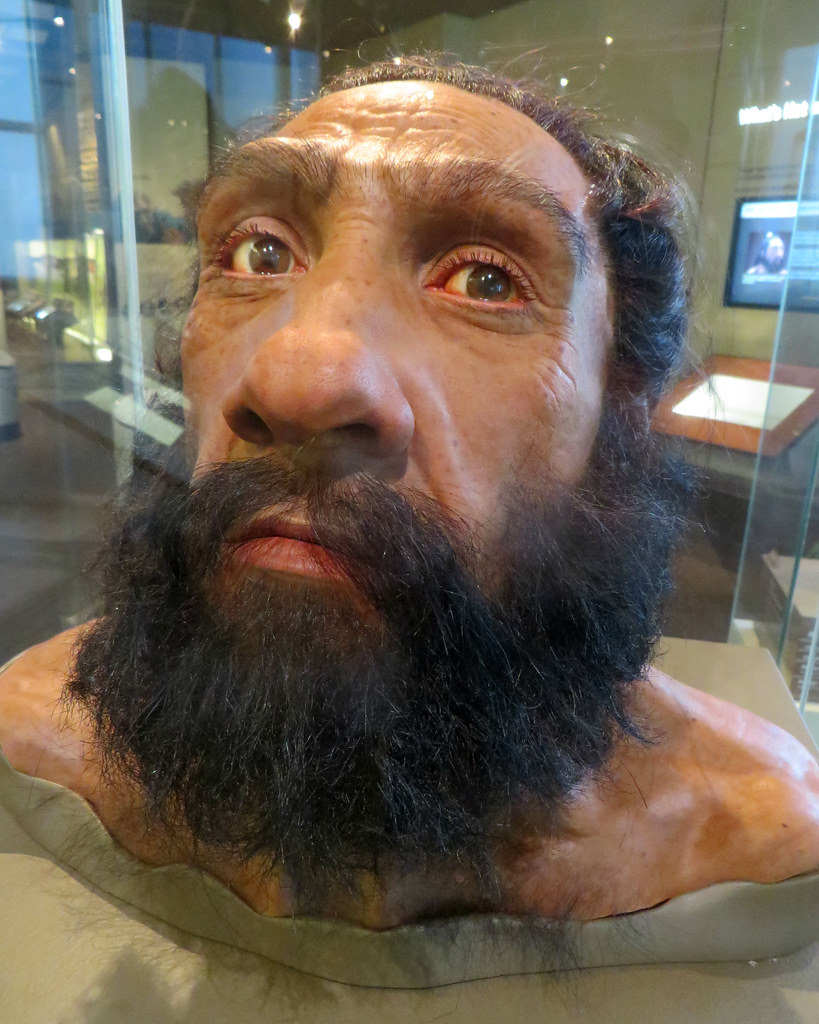
Neanderthals evolved in Europe and western Asia from an earlier population of Homo, and their lineage goes back at least 400,000 years. Fossils from the Sima de los Huesos ("Pit of Bones") in Spain show early Neanderthal features around 430,000 years ago. Their bodies were short and stocky, with broad chests and big noses, a build that helps conserve heat. Their brains were, on average, as large as ours or a little larger, though shaped differently.
Culture, care and craft
Archaeology over the last few decades has transformed the picture:
- Care for the injured. At Shanidar Cave in Iraq, excavated by Ralph Solecki from the 1950s, one man had survived a withered arm, a crushed eye socket and hearing loss for years. He couldn't have done so without help.
- Burial. Several sites show Neanderthals deliberately placed their dead in pits. A famous claim that one burial at Shanidar was covered in flowers is now doubted, but a new skeleton found there in 2018 has renewed interest in Neanderthal funerary behaviour.
- Jewellery. At Krapina in Croatia, eagle talons about 130,000 years old show cut marks and polish, as if worn on a necklace.
- Glue. Neanderthals made birch-bark tar to haft stone points onto wooden handles, a process that requires controlled heating.
- Symbols? A crosshatched engraving in Gorham's Cave, Gibraltar, and rings of broken stalagmites built deep inside Bruniquel Cave in France about 176,000 years ago suggest planning and perhaps symbolic thinking. Claims of Neanderthal cave paintings in Spain remain debated.
The genome that changed everything
In 2010, a team led by Svante Pääbo at the Max Planck Institute in Leipzig published a draft genome of a Neanderthal, sequenced from DNA extracted from fossil bones. It was a technical miracle: ancient DNA is broken into tiny pieces and badly contaminated with bacterial and modern human DNA.
The biggest surprise was that people living outside Africa today carry a small amount of Neanderthal DNA, roughly one to two percent of their genomes. Our ancestors and Neanderthals had met, and had children, probably mostly around 45,000–50,000 years ago in western Asia. Genomes from early modern humans found in Germany and Czechia, published in 2024, helped pin down the timing. Later research showed some Neanderthal DNA reached African populations too, through people migrating back.
Pääbo received the 2022 Nobel Prize in Physiology or Medicine for this work. Some Neanderthal gene variants we carry today affect our immune systems and skin, and one has been linked to a higher risk of severe COVID-19.
Why did they disappear?
Neanderthals vanish from the fossil record around 40,000 years ago, a few thousand years after Homo sapiens spread into Europe. There's no single agreed explanation. Possibilities include competition with modern humans, small and isolated populations, climate swings, and absorption through interbreeding. Most likely it was a mix. In a sense, they didn't entirely disappear. A bit of them lives on in billions of people.